1949
Art Tusvik joins the band.
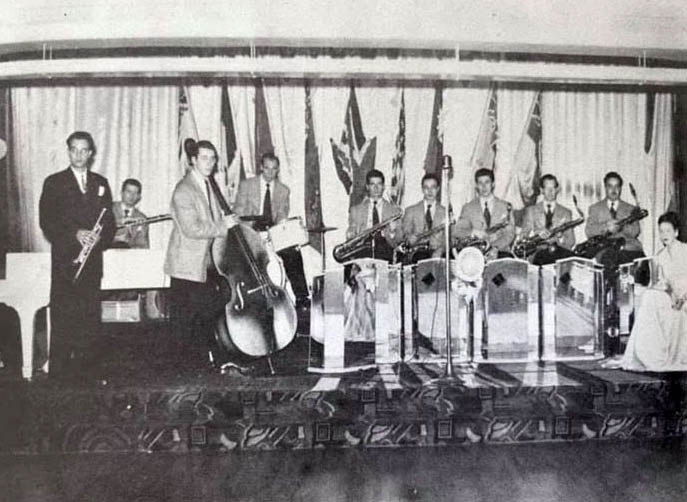
Gordon Delamont disbands his orchestra and retires from the orchestra-leading business at the conclusion of their third winter at the Top Hat in 1949. Except for rehearsal bands and experimental groups, he never returns to it again.
Other than trumpet lessons from his father and casual help from Gordon Edwards, Gordon has had virtually no formal training in the matter of writing music. He has, however, always been interested in the principle behind the fact. He finds himself becoming more and more interested as to the ‘why’ of this fact and all of the other facts that he has encountered, in arranging for Richards, for Bogart and for his own orchestra. So, believing that the best way to learn any subject is to write a book about it, he decides to do exactly that.
At that time, books which purported to teach anything in twenty lessons were very popular so he decides to adopt that format and write a book called ‘Learn Modern Arranging in Twenty Lessons.’ Around this time he has encountered pamphlets by Dr. Maury Deutsch of New York which uses the harmonic overtone series as a point of reference. While he doesn’t know very much about the harmonic overtone series, he has begun to suspect that it is a major factor in music generally. So he makes plans to go to New York. He studies – two lessons a day for two weeks with Dr. Deutsch.
After a little more time spent with Dr. Deutsch he decides to return to Toronto, determined to try to make a living through the private teaching of arranging and composition. He finds a suitable studio, sets up an advertising campaign with the help of Mr. Hank Rosati, a friend and the lead saxophone player in his now defunct orchestra. He never teachs in any manner other than privately.
Although he has over a dozen offers of teaching posts and professorships from universities and colleges in Canada and the United States throughout the 50s, 60s and 70s he feels that he would not cope well with faculty meetings, courses structured into rigid time frames, nor with political infighting and jockeying for position that seem to be part of institutional education. He does however lecture in colleges and universities and does some adjudicating.
Shortly after he begins teaching, one of his students, Russ Messina, comes in every week from Buffalo, NY. He has gradually been discarding his ‘Twenty lessons’ book as the chief reference in his teaching but Russ thinks he should show it to friends of his who operate Kendor Music Incorporated. After looking the book over Kendor is interested in publishing it, giving him full author’s credits and royalties.
However, by then Gordon is disenchanted with the ‘Twenty Lessons’ format of the book. There isn’t nearly enough information. He does not want it to appear as a formal book. Instead he approaches Art Dedrick, the president of Kendor with a proposition. He suggests that he will write a totally new book on arranging and, when it is completed, he can publish it if he likes it. Dedrick accepts his offer. Gordon writes the book – which is probably ten times the size of his ‘Twenty Lessons’ opus, over the next two years, while continuing to make a living teaching and playing trumpet professionally. It is a productive period of his life but ultimately takes its toll on his health, which was never robust anyway. Fortunately, Mr. Dedrick likes the book and publishes it. He says that he hopes the book will still be selling ten years from then.
After the success of his arranging book, it is not too difficult to have Kendor publish further texts that he will write over the years. These include two large books on harmony, a book on melody, one on modern counterpoint and one on the twelve-tone technique. Gordon bases his own teaching process on these books. They are used in the curriculum, or at least as required reading, in the music faculties of a large number of universities and music colleges throughout Canada and the United States and some other countries where North American styles of music are taught.
During the 1950’s most of his professional trumpet playing, aside from some television studio work, is done with an orchestra conducted by Les Foster – a man who is the epitome of what a professional musician should be. For Gordon this removes the aggravation of having to deal with the eccentric, spurious and spuriously eccentric jobbing band leaders who seem to proliferate in Toronto. Consequently, he is able to devote more time and energy to aspects of music, such as teaching and writing books, that have become of more interest to him.
The fifties is an exciting time for those who are interested in the development and writing of jazz music. The decade sees the development of jazz composition which is labeled ‘third stream’ music by the American composer Gunther Schuller. It is music which is an amalgam of jazz and ‘classical’ elements, and takes divergent avenues. Spearheading jazz composition in Toronto are two men who Gordon is fortunate enough to have as his students, Ron Collier and Norm Symonds. Both of them organize groups to provide vehicles for their music and with which they can experiment.
In the last years of the fifties, Gordon finds himself becoming more interested in jazz composing, rather than just dispensing, as a teacher, approval and criticism. Taking a cue from Collier and Symonds, he organizes a group of musicians to use as a vehicle to write for. He has excellent success playing concerts, making television appearances, etc. He writes a large body of music during this time, much of it published, some of it recorded. (Gordon Delamont’s Memoirs, Prof. arranger, composer, teacher)
Quotes from Ambassadors of Empire Seasone 2 Episode 6:
 Ambassadors of Empire Online